Prompt Engineering is Dead? Long Live System Engineering
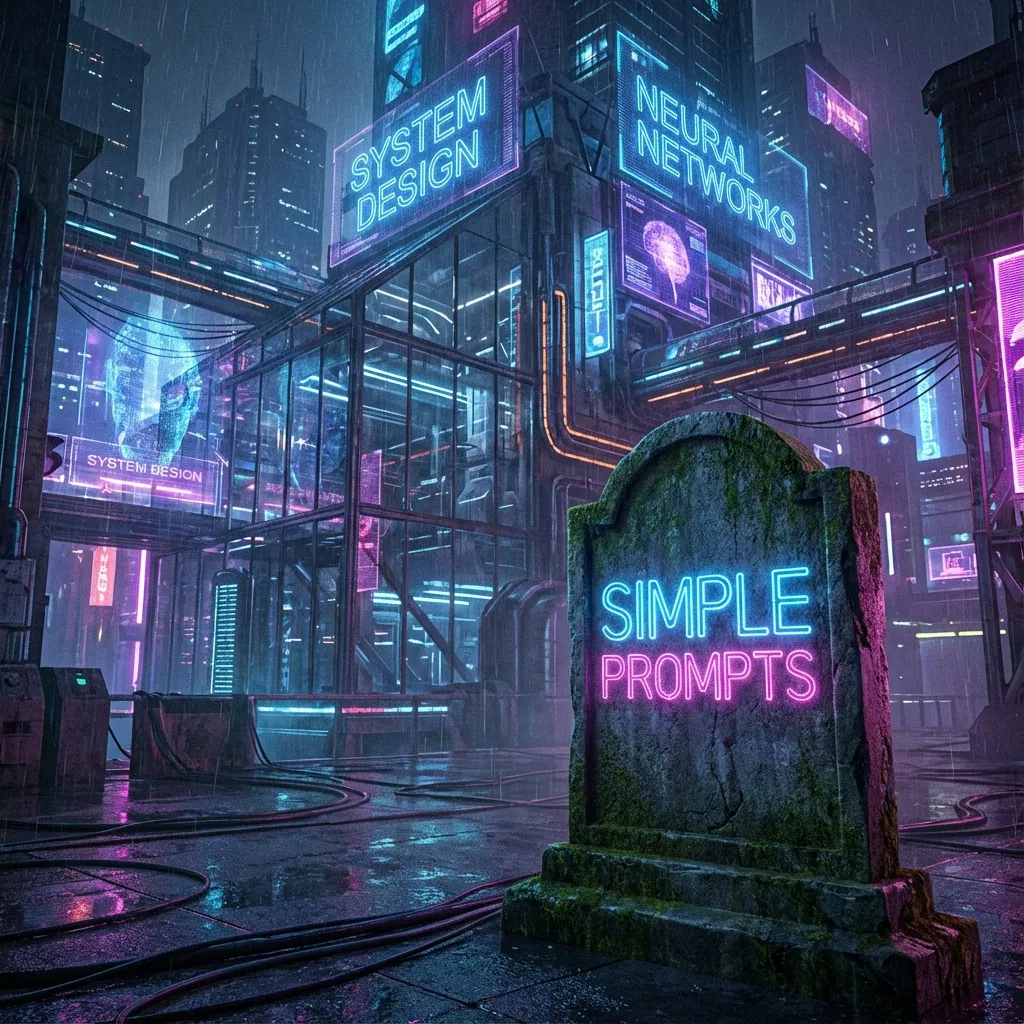
Two years ago, when ChatGPT first stormed the scene, the most common new title on LinkedIn and X was “Chief Prompt Engineer.” People were obsessed with finding that one magic word or adding “Take a deep breath” to get better results, as if they were performing some form of digital alchemy.
By 2025, that title is rapidly disappearing.
This doesn’t mean prompting is no longer important; quite the opposite. It has become so essential that it has been internalized as a foundational skill for every AI builder, much like SQL is for a backend engineer.
The era of “guessing magic spells” is over. What we need now is Prompt System Engineering.
1. The Framework Mindset: Depth with CO-STAR
Most people write prompts like a stream of consciousness—writing as ideas come. While models can understand this, they often miss the core intent. You need a structured framework to constrain and guide the reasoning.
The CO-STAR framework, developed by the Singapore Government Technology Agency, remains the gold standard:
- C (Context): Provide the background information. Put the model in character.
- O (Objective): Define exactly what needs to be accomplished.
- S (Style): Specify the writing style (e.g., Paul Graham, technical documentation).
- T (Tone): Set the emotional resonance (e.g., authoritative, witty, empathetic).
- A (Audience): Who is the recipient? A primary school student or a quantum physicist?
- R (Response): Precisely specify the output format (Markdown, JSON, XML).
❌ The Lazy Prompt:
Help me write a blog post about AI.
✅ The CO-STAR Prompt:
# Context I am running a technical blog for senior software engineers (5+ years exp) focusing on the practical implementation of AI in backend architectures.
# Objective Write a deep-dive analysis into retrieval challenges in RAG systems, comparing semantic search vs. keyword search.
# Style Hard-core technical, suitable for Hacker News or a technical whitepaper. Minimize marketing fluff; maximize engineering heuristics and code metaphors.
# Tone Professional, objective, and critical, with a touch of geek humor.
# Audience Full-stack developers familiar with Vector DBs and LLM basics. Do not explain what an Embedding is; dive straight into the trade-offs.
# Response Format Use Markdown. Include H2/H3 headers. Use italics or bold for emphasis. If describing algorithm logic, use Mermaid diagram blocks.
When you structure your prompts, you’ll find that output stability increases by an order of magnitude.
2. Structured Reasoning: Explicit Chain of Thought (CoT)
LLMs are essentially probabilistic machines. When you ask for an immediate answer, the model relies on its “intuition” to guess the next token. When you force it to think before answering, it transitions into “reasoning.”
While OpenAI’s o1 model has internalized CoT, explicitly directing a model to “think step-by-step” remains the most effective way to boost logical accuracy for faster, cheaper models like GPT-4o-mini or Claude 3.5 Haiku.
But don’t just say “Think step-by-step.” Define the steps of thought.
Task: Analyzing a potential phishing email
# Instruction Perform the following analysis steps sequentially. Do not skip any step:
Step 1: Header Analysis Inspect the sender address (
<sender_email>). Is it from an official domain? Check for homograph attacks (e.g.,paypa1.com).Step 2: URL Consistency Extract all links. Compare “Display Text” vs. “Actual URL.” Do they point to suspicious third-party shorteners or IP addresses?
Step 3: Psychological Triggers Analyze the tone. Is there manufactured Urgency, Panic, or Greed?
Step 4: Conclusion Based on the above, provide a final verdict (LEGIT / PHISHING / SUSPICIOUS) and a confidence score.
By doing this, you are effectively writing “pseudocode” in natural language, forcing the model to follow your logical flow.
3. Dynamic Prompting: The RAG + Few-Shot Paradigm Shift
Never expect a model to perfectly grasp a complex intent via Zero-shot. Dynamically injecting 3-5 high-quality examples (Few-Shot) into the System Prompt is the most immediate way to improve results.
In a production environment, examples should not be hardcoded. Different tasks require different context. This is where Prompt Engineering merges with RAG.
Architectural Design:
- Establish an “Example Store” containing 100+ perfect Prompt-Response pairs.
- When a user query arrives, perform a vector search against the Example Store.
- Retrieve the top 3 most relevant examples.
- Dynamically inject them into the System Prompt.
You are a SQL expert. Use these examples as a reference for your logic:

---
User: Who was the top seller last month?
AI: SELECT * FROM sales WHERE date >= DATE('now', 'start of month', '-1 month') ORDER BY amount DESC LIMIT 10;
---
User: {Dynamic_Example_2_Input}
AI: {Dynamic_Example_2_Output}
---

Now, answer the user's latest query:
User: {Current_User_Input}
This Dynamic Few-Shot approach can lift accuracy on specialized tasks (like Text-to-SQL or code generation) from 60% to over 90%.
4. Modular Prompts: Write Prompts Like Code
In complex Agent systems, your prompt may span thousands of words. Maintaining a massive string is unsustainable. We need to borrow from software engineering’s Modularity.
Split your prompt into independent, reusable components:
<Role_Definition><Tool_Specs><Output_Schema><Safety_Guardrails>
At runtime, assemble these modules based on the specific task. For a “read-only” task, you physically omit the “database write tool” description, programmatically preventing the model from making accidental destructive changes.
Summary
Stop looking for “magic spells.” The endgame of prompt engineering isn’t creative writing—it’s Natural Language Programming.
You must treat your prompts like code:
- Version Control: Your prompts deserve
git commit. - Modularity: Decouple and reuse components.
- Unit Testing: Establish a Golden Dataset and run regression tests after every prompt tweak.
When you start writing prompts with an engineer’s mindset, you finally unlock the true power of LLMs.
Evidence boundary and current guidance
Reviewed July 13, 2026. The “60% to over 90%” statement above is an illustrative range, not a result established by this article; do not reuse it as a benchmark. Dynamic few-shot selection can improve a task when the examples and retrieval strategy are good, but it can also add latency, cost, and misleading examples.
Do not request or store hidden chain-of-thought as an application requirement. Prefer concise, auditable outputs, structured fields, tool results, and task-specific evaluations. Prompt templates should be versioned together with the model snapshot, test set, scoring code, and failure examples.