Thinking Like an Agent: Mental Models for Building AI Applications
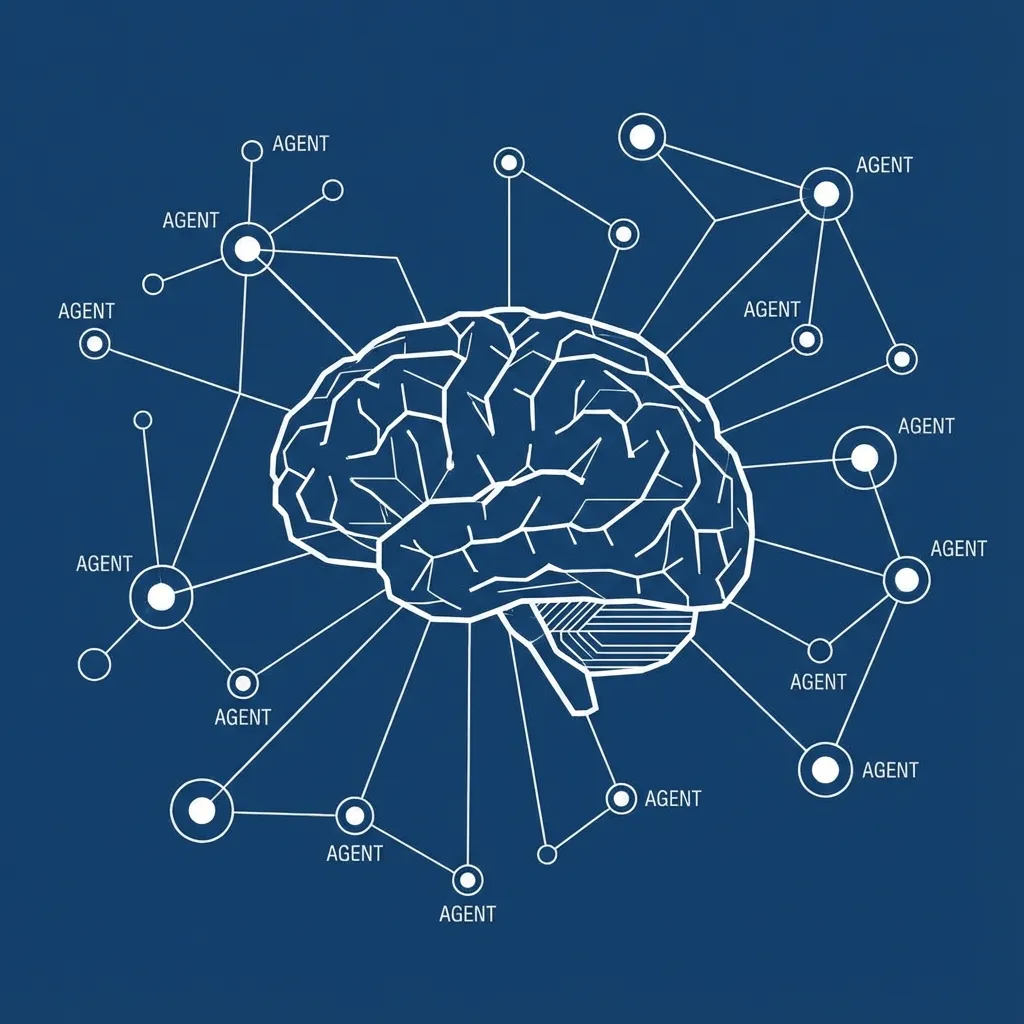
As technical professionals, we often rely on old metaphors to understand new technologies.
- We view Blockchain as an “immutable distributed database.”
- We see React as an “auto-refreshing template engine.”
- And we treat LLMs as “knowledgeable chatty databases.”
This is the biggest pitfall in AI development today. If you’re frustrated that ChatGPT gives inaccurate answers or “hallucinates,” you might still be using it like a search engine.
When building AI Agents, we need a fundamental paradigm shift: LLMs are Reasoning Engines, not Knowledge Bases.
1. The “New Employee” Metaphor
Imagine you are the CEO of a consulting firm. You’ve just hired a brilliant, Ivy League graduate intern who is a bit literal-minded.
Their Profile:
- Exceptional Reasoning: They excel at reading comprehension, logic, and synthesis. They can extract core insights from a chaotic pile of documents.
- Stateless & Zero Context: They just started and know nothing about your specific business. If you ask, “What was our Q4 net profit last year?”, they don’t have that data. To be helpful, they might make up a number (hallucination).
- Strict Instruction Following: They will use exactly the tools you provide, no more, no less.
As a leader (the developer), how should you manage this employee?
❌ The Wrong Way (Treating them as a Knowledge Base):
“Hey intern, tell me what our net profit was last year.” Result: The intern makes something up. You check the records, find out it’s wrong, and conclude AI is useless.
✅ The Correct Way (Treating them as a Reasoning Engine):
“Hey intern, here is the API access to our internal database (Tool), and here is the path to our financial reports (Context). Use these tools to query last year’s data, calculate the net profit margin, and summarize three key takeaways.” Result: The intern calls the API, gets the real data, and applies their reasoning skills to provide a masterful analysis.
This is the essence of RAG (Retrieval-Augmented Generation) and Agents. We don’t expect the LLM to “remember” facts (knowledge in training data is compressed, lossy, and outdated). We leverage its “reasoning” capability to process the real-time information we provide.
2. The Agentic Loop: Plan - Act - Check
Humans solve complex problems by subconsciously breaking them down into steps. Modern AI systems must explicitly design this cycle.
This is the core philosophy behind the ReAct (Reason + Act) framework.
Phase 1: Planning
When receiving a vague instruction (e.g., “Book me a cheap flight to Tokyo”), the LLM shouldn’t jump straight to an API call. It first generates a plan.
- Thinking: Where is the user departing from? What dates?
- Thinking: What does “cheap” mean? Direct or layovers?
- Plan: 1. Clarify departure city and dates. 2. Search flights. 3. Sort by price.
Phase 2: Execution
Following the plan, the LLM selects the appropriate Tool.
This highlights the LLM’s value as a Router. Traditional software struggles to distinguish between “booking a flight” and “checking the weather” without hardcoded if (intent === 'book_flight') logic. An LLM can automatically route based on semantic intent.
Phase 3: Reflection (Check)
This is the most neglected phase but the differentiator between a demo and a production-ready system. The LLM might generate incorrect API parameters or code that doesn’t run. We need to introduce a Critic role (often another LLM or a self-reflection step).
Agent: Calls
weather_api({ city: "Beijing" })Environment: Returns 200 OK Critic (Self-Reflection): Wait, the user asked for “tomorrow,” but the API returned “current weather.” This doesn’t meet the goal. I need to re-callweather_api({ city: "Beijing", date: "tomorrow" }).
This Self-Correction loop is the key to building robust Agents.
3. Future Architecture: Merging Probability and Determinism
The software architecture of the future won’t be a hardcoded logic tree (if-else). It will be probabilistic modules connected by natural language.
-
Traditional Software:
- Input: Deterministic data (Click Events, JSON).
- Process: Deterministic logic (Code).
- Output: Deterministic UI changes.
-
AI Software:
- Input: Fuzzy intent (Natural Language).
- Process: Prompt Chains + Reasoning. A probabilistic process.
- Output: Execution results.
This architecture demands high Fault Tolerance, but the Possibilities it unlocks are limitless.
4. Abandon the “All-Knowing” Illusion
Models will get smarter, from GPT-4 to GPT-5 and beyond. But as developers, we shouldn’t wait for the perfect model.
Even the smartest human employees make mistakes. Strategy lies in designing the Workflow and Guardrails that allow an imperfect employee to produce perfect results.
- Offload memory to Vector Databases.
- Offload precise calculations to Python code and calculators.
- Offload logical reasoning to the LLM.
This is the ultimate philosophy of AI development in 2025.
Limits of the mental model
Reviewed July 13, 2026. “LLM as a new employee” is a teaching metaphor, not a security or architecture model. Models do not reliably follow instructions, reason consistently, know when they are wrong, or preserve state unless the application supplies those controls.
Plan–Act–Check loops can improve some multi-step tasks, but they also increase latency, cost, and the number of failure points. Use deterministic code for permissions, money movement, validation, and irreversible actions. Evaluate the complete workflow on representative tasks instead of assuming that an additional critic model guarantees correctness.