Stop Comparing Claude Skills and MCP: They Solve Different Problems
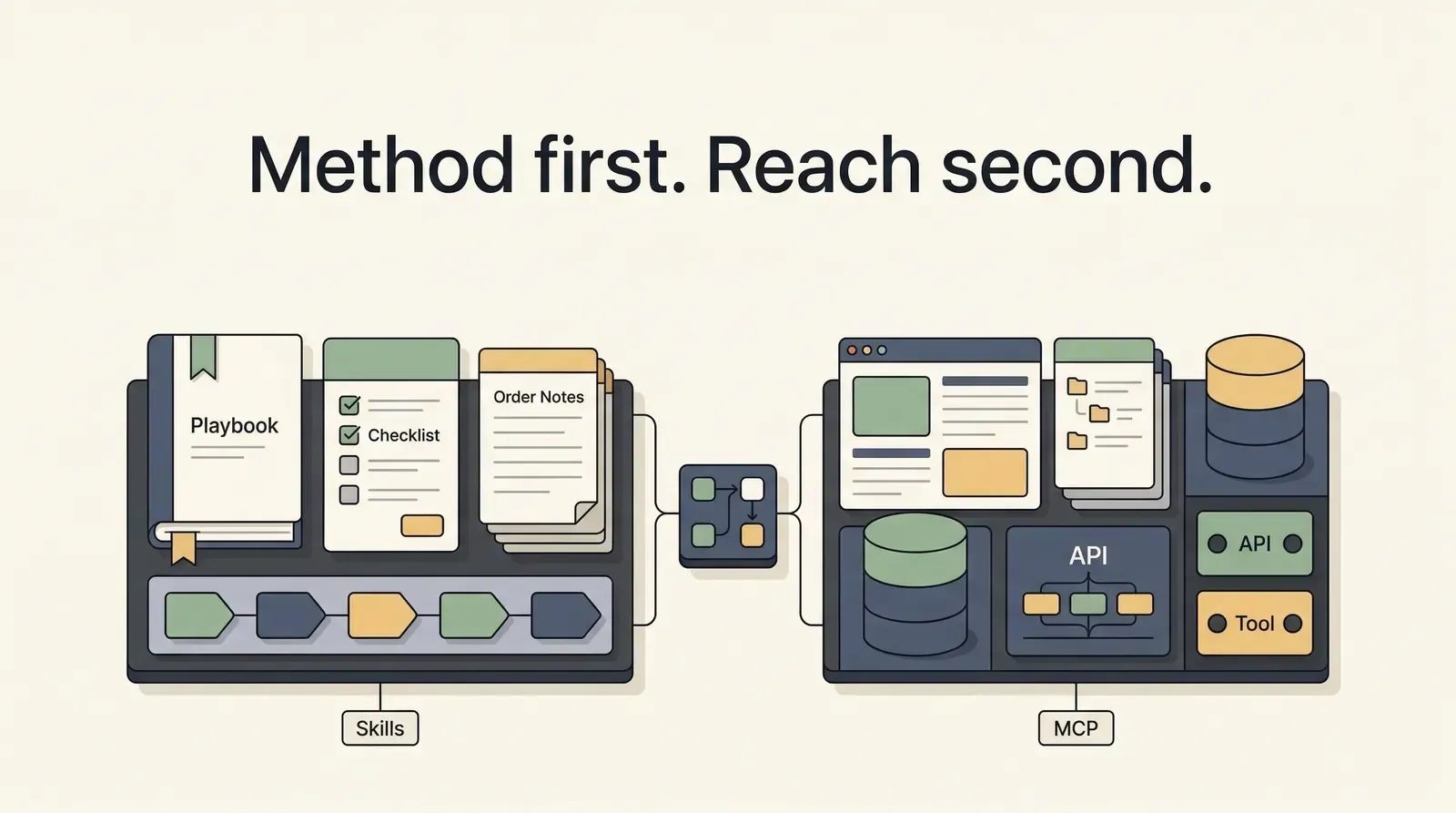
People love asking whether Claude Skills or MCP is the more powerful primitive.
That question sounds reasonable until you actually try to build something with both. Then the confusion shows up immediately. You reach for Skills when the real problem is missing data. Or you wire up MCP when the real problem is that the model has no stable workflow and keeps improvising.
The issue is not that these two ideas overlap too much. The issue is that they get discussed as if they belong to the same category.
They do not.
The short version is simple:
Skillstell Claude how to work.MCPlets Claude connect to things outside the prompt.
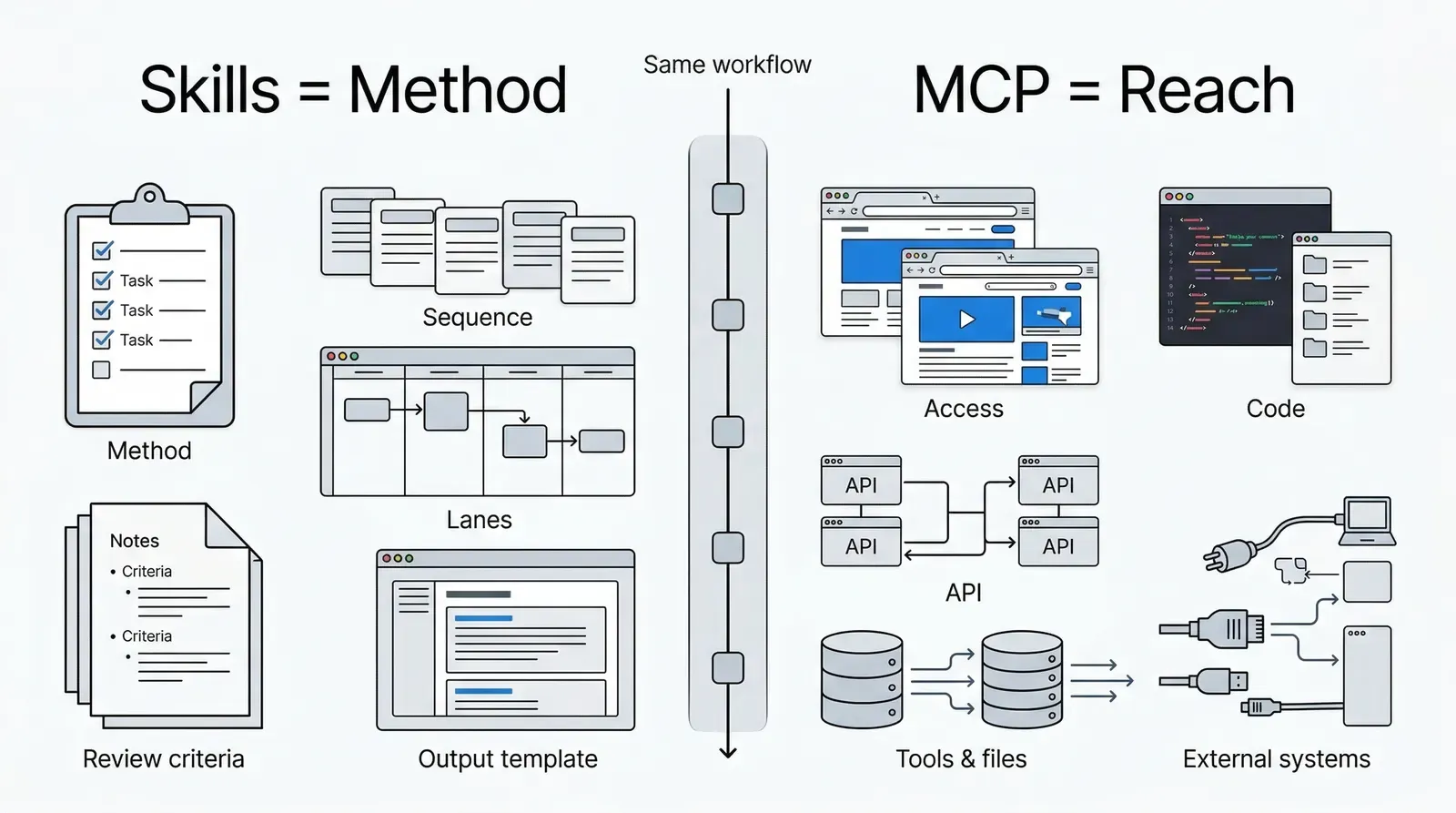
Once you separate those two responsibilities, most of the architecture decisions get much easier.
Skills are not tools. They are operating instructions.
The easiest way to misunderstand Skills is to treat them like plugins.
They are not useless if you think about them that way, but you miss the point. A Skill does not primarily exist to give Claude another button to press. It exists to stop Claude from wandering.
That matters more than most people expect.
When you add a Skill, you are usually defining things like:
- when a workflow should trigger
- what sequence of steps Claude should follow
- what quality bar the output must meet
- what pitfalls should be checked before the work is considered done
- what format the final output should take
In other words, a Skill is best understood as method packaged as reusable context.
If you want Claude to write a technical blog post by first identifying audience, then narrowing the claim, then structuring sections, then cutting empty phrases, that is a Skills problem.
If you want Claude to review code using a fixed checklist, that is also a Skills problem.
The recurring pattern is the same: the hard part is not access. The hard part is discipline.
MCP is not a methodology layer. It is a capability layer.
MCP solves a different class of problem.
It does not tell Claude how to think. It gives Claude a structured way to interact with external systems:
- GitHub
- local files
- browsers
- databases
- APIs
- internal tools
That is why MCP often feels more “practical” the first time people use it. The model suddenly stops relying on memory and inference alone. It can read, query, fetch, inspect, and act.
But that extra reach does not automatically make the output better.
If the workflow itself is messy, MCP can scale the mess.
You can end up with a model that now has access to five different systems and still produces noisy results because nobody told it what good work looks like.
That is not a tooling failure. That is a design failure.
The real question is not “Which one is stronger?”
The real question is:
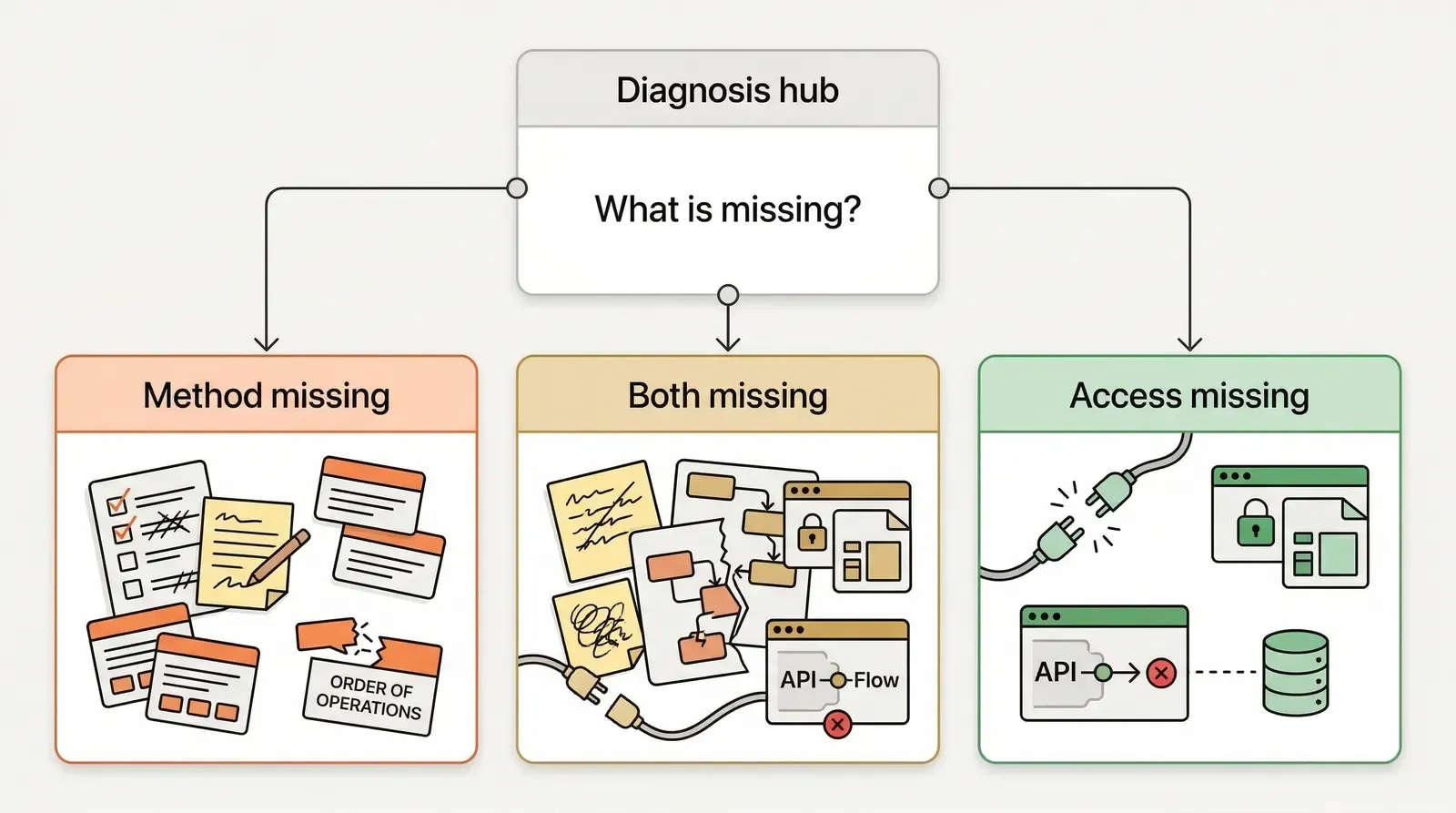
What is missing from the workflow right now?
There are only two serious answers:
- The model lacks a stable way of working.
- The model lacks access to the information or tools it needs.
If you are dealing with the first problem, reach for Skills.
If you are dealing with the second, reach for MCP.
That sounds obvious when stated plainly, but most teams skip this diagnostic step. They jump straight to implementation. Then they wonder why the setup feels powerful and inconsistent at the same time.
Use Skills when the problem is method
Skills are the right primitive when you care about:
- workflow order
- review criteria
- output structure
- consistency across tasks
- repeatable standards
That makes them especially useful for work like:
- code review
- technical writing
- refactoring checklists
- debugging workflows
- incident writeups
- release procedures
The common thread is that these tasks benefit from a repeatable process, not just raw access to more systems.
If your AI writing workflow is weak because the article keeps turning into vague, bloated prose, MCP will not save you. That is a methodology problem. You need a stronger writing workflow, stronger editorial constraints, and clearer structure. In other words, you need Skills.
Use MCP when the problem is reach
MCP becomes necessary when Claude needs structured access to external reality.
That includes cases like:
- reading repository state before summarizing changes
- querying a SQLite database before answering a product question
- inspecting a browser page instead of guessing why the UI broke
- fetching docs or system metadata from a controlled source
This is where MCP is excellent. It turns “I think” into “I checked.”
That shift is not cosmetic. It is the difference between:
- plausible output
- defensible output
For serious engineering workflows, that difference matters a lot.
Most useful systems end up using both
The popular framing is Skills vs MCP.
The reality is usually Skills + MCP.
Take a writing workflow as an example.
Suppose you want Claude to help produce a technical article that is actually publishable. A good workflow may need all of the following:
- a Skill that forces the article into a strong structure
- a Skill that removes filler and marketing language
- MCP access to the local repository for real code references
- MCP access to docs or source material
- MCP access to images, files, or internal notes
In that setup:
Skillsdecide how the work should happenMCPdecides what the work can touch
That division of labor is the useful mental model.
A simple decision rule
If you do not want to overcomplicate this, use this rule:
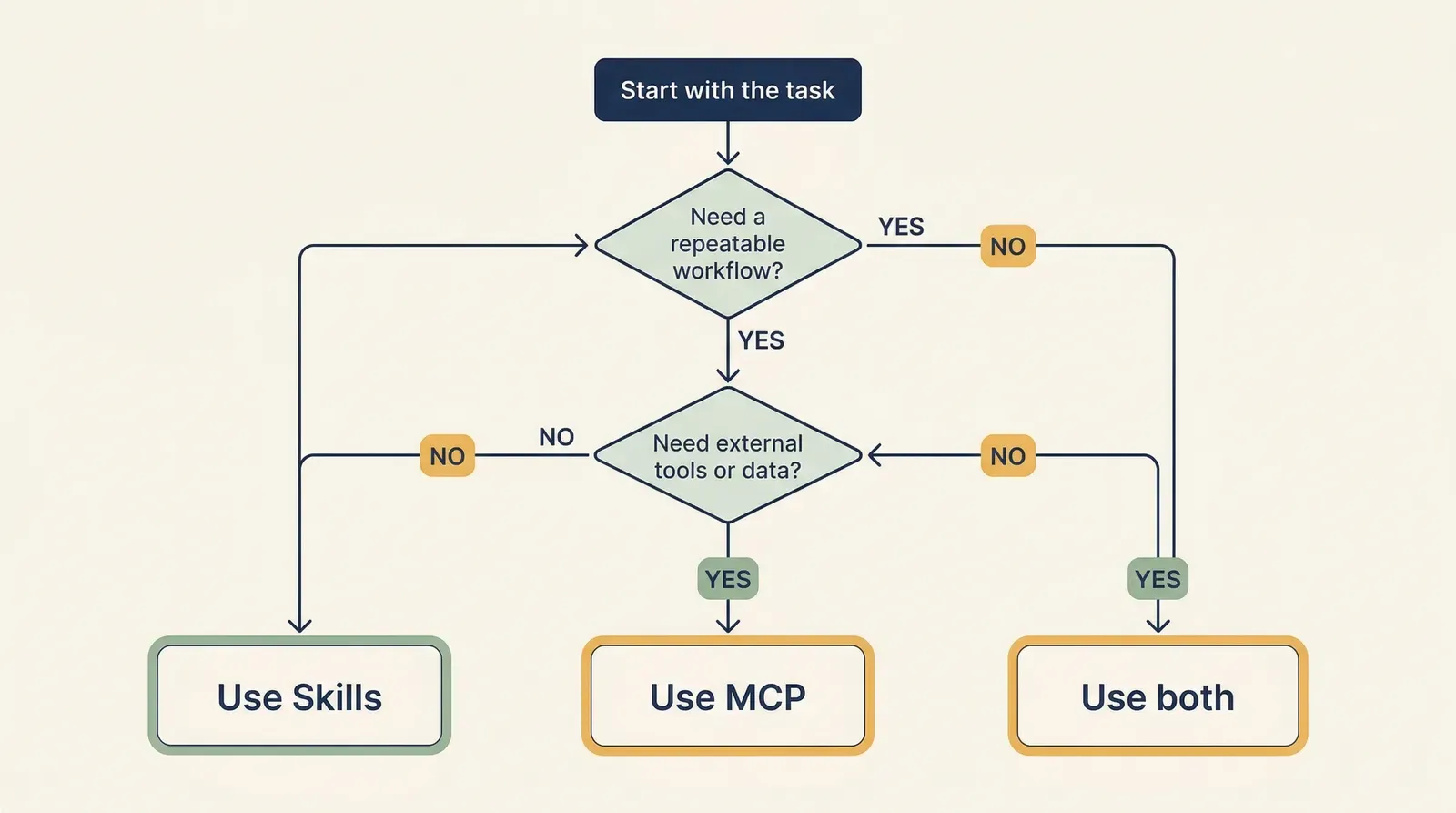
Start with three questions
- Does this task have a repeatable workflow?
- Does this task require external data or tools?
- Is the current bottleneck quality or access?
Then decide like this:
- fixed workflow, no external data: use
Skills - external systems, little workflow complexity: use
MCP - both: use both
That is usually enough to make the right first architecture decision.
When not to start with MCP
It is tempting to wire up MCP everywhere because it feels like the more advanced capability. In practice, that is often the wrong first move.
If the real problem is that the model produces inconsistent output, adding more tools usually gives you more variability, not more quality.
You will get:
- more data
- more context
- more tool calls
- more motion
but not necessarily better work.
If you have not yet stabilized the workflow, fix that first. A clean method usually improves results faster than a broader tool surface.
When not to rely on Skills alone
The reverse mistake is also common.
If you already have a good workflow but the model still lacks real grounding, Skills alone will hit a ceiling quickly.
This shows up when:
- every summary requires manual copy-paste
- repository changes need to be rewritten by hand
- product facts are pulled from memory instead of systems
- the article sounds coherent but thin
That is the limit of workflow without reach.
At some point, better method is no substitute for better inputs.
The most practical way to think about it
Do not think of Skills and MCP as competing abstractions.
Think of them as separate answers to separate questions:
Skills: What does good work look like here?MCP: What does the model need access to in order to do that work?
Once you frame it that way, the architecture stops being philosophical and starts being operational.
That is where these tools become genuinely useful.
Closing
So no, the interesting question is not whether Skills are better than MCP, or whether MCP is more “powerful.”
That is like asking whether code review standards are more important than database access. Both matter. They just solve different failures.
If you are building real AI workflows, the better habit is this:
Define the method first. Then expand the reach only where the method actually needs it.
That sequence is usually slower for the first hour and much faster for the next six months.